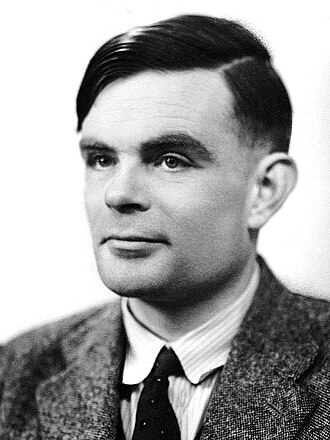
Quick facts
- Lifespan
- 23 June 1912 – 7 June 1954
- Alma Mater
- King's College, Cambridge; Princeton University
- Known For
- Turing Machine, Enigma decryption, Turing Test, ACE computer, Morphogenesis
- Wartime Role
- Lead cryptanalyst at Hut 8, Bletchley Park
- Posthumous Honor
- Featured on the Bank of England £50 banknote; Royal Pardon (2013)
Universal Computation: The 1936 Turing Machine
In 1936, at just 24 years old, Alan Turing published his landmark paper, 'On Computable Numbers, with an Application to the Entscheidungsproblem'. In it, he resolved David Hilbert's fundamental question of whether mathematics could be fully mechanized by proving that no universal algorithm exists to determine whether an arbitrary mathematical statement is provable.
To prove this, Turing introduced the concept of an abstract computing device—now called the Turing Machine—consisting of an infinite tape, a read/write head, and a state register. He demonstrated that a single 'Universal Turing Machine' could simulate the operation of any other computing machine by reading its program from the tape, inventing the conceptual foundation of the stored-program computer.
Wartime Cryptanalysis at Bletchley Park
During World War II, Turing was a leading codebreaker at the Government Code and Cypher School (GC&CS) at Bletchley Park. He headed Hut 8, the section responsible for decrypting German naval Enigma messages.
Turing designed the electromechanical 'Bombe' machine, which could test thousands of potential Enigma rotor configurations simultaneously. His statistical method of 'Banburismus' drastically reduced the number of tests required, allowing allied naval forces to intercept and avoid U-boat wolfpacks in the Battle of the Atlantic, shortening the war in Europe by an estimated two to four years.
Key Milestones & Timeline
- 1931–1934King's College, Cambridge
Graduates with first-class honours in mathematics and is elected a Fellow of King's College at age 22.
- 1936Universal Turing Machine Formulated
Publishes 'On Computable Numbers', establishing theoretical computer science and computability theory.
- 1938PhD from Princeton University
Completes doctoral dissertation on ordinal logic under Alonzo Church.
- 1939–1945Bletchley Park Codebreaking
Develops the Bombe machine and decrypts German naval Enigma ciphers.
- 1945–1948Automatic Computing Engine (ACE)
Designs one of the earliest stored-program electronic computers at the National Physical Laboratory.
- 1950The Turing Test & AI Foundations
Publishes 'Computing Machinery and Intelligence', proposing the Imitation Game to evaluate machine intelligence.
Foundations of Artificial Intelligence
In 1950, Turing published his seminal philosophical paper 'Computing Machinery and Intelligence' in the journal Mind. He opened with the question, 'Can machines think?' and proposed what is now known as the Turing Test (the Imitation Game): if a human evaluator cannot reliably distinguish between text conversations with a machine and a human, the machine exhibits intelligent behavior.
Primary References & Scientific Papers
Foundational paper defining universal computation and Turing machines.
Seminal paper introducing the Turing Test (Imitation Game).
Pioneering mathematical biology paper on biological pattern formation.
Forest Trails
- Proposed Test For
- Theoretical Foundation In
- Preceded By