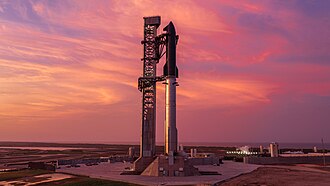
Quick facts
- Developer
- SpaceX
- Height
- 121 meters (397 ft)
- Thrust at Liftoff
- 16.7 Million lbf (74 MN)
- Payload to LEO
- 100-150 Tonnes (Fully Reusable)
- Primary Fuel
- Liquid Methane + Liquid Oxygen (Methalox)
Overview
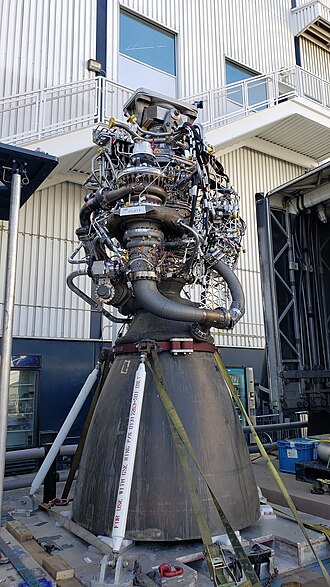
Starship represents SpaceX bid to achieve 100% full and rapid vehicle reusability for orbital class rocketry. The two-stage system comprises the Super Heavy booster (powered by 33 full-flow staged-combustion Raptor engines) and the Starship second-stage spacecraft (powered by 3 sea-level and 3 vacuum-optimized Raptor engines).
Constructed from 304L stainless steel rather than carbon fiber or aluminum-lithium alloy, Starship withstands cryogenic temperatures while providing superior strength at high thermal entry velocities. On October 13, 2024 (Flight 5), SpaceX successfully returned the Super Heavy booster directly to the launch site, catching it in mid-air using mechanical chopstick arms on the launch tower.
Flight Test Milestones
- 2019Starhopper 150m Hop
First untethered flight of Raptor engine in Boca Chica, Texas.
- 2021SN15 High-Altitude Landing
First successful 10km atmospheric flip maneuver and soft touchdown.
- 2023Integrated Flight Test 1 & 2
First combined orbital stack launches demonstrating hot-staging separation.
- June 2024Flight 4 Controlled Splashdowns
Super Heavy and Starship both achieved soft water landings through atmospheric plasma.
- October 2024Flight 5 Tower Catch
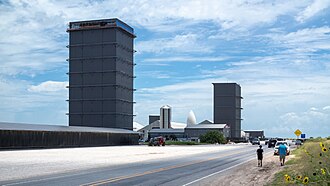
Super Heavy caught in mid-air by mechanical launch tower arms at Starbase.
Forest Trails
- Developed By
- Propulsion System
- Sister Vehicles
- Missions & Partners