Quick facts
- Architecture
- Decoder-only / Encoder-Decoder Transformer
- Training Objective
- Autoregressive Next-Token Prediction
- Scale
- 7B to 1.8T+ parameters
- Core Capabilities
- In-context learning, few-shot prompting, code synthesis, reasoning
- Key Alignment Technique
- Reinforcement Learning from Human Feedback (RLHF) / DPO
How Large Language Models Work
At their core, Large Language Models are statistical next-token prediction systems. Text is broken down into sub-word tokens and mapped into high-dimensional vector spaces (embeddings). Through dozens of stacked Transformer layers, the self-attention mechanism computes pairwise relationship weights between every token in the context window simultaneously.
By training across trillions of tokens of diverse literature, code, and technical discourse, the model develops an internal world model capable of grammatical mastery, algorithmic reasoning, and multi-step problem solving without task-specific engineering.
The Three Stages of Modern LLM Training
- 1. Pre-training
- Massive self-supervised next-token prediction across trillions of tokens on thousands of GPUs, imparting base knowledge and reasoning abilities.
- 2. Supervised Fine-Tuning (SFT)
- Instruction tuning on curated high-quality demonstration dialogues to teach the model to act as an assistant and follow user prompts.
- 3. Alignment (RLHF / DPO)
- Reinforcement Learning from Human Feedback or Direct Preference Optimization to steer model outputs toward helpfulness, accuracy, and safety.
Foundational Research Papers
Brown et al. (OpenAI)
Kaplan et al.
Forest Trails
- Subfield Of
- Accelerated By
- Develops Models In
- Implemented In
- Powered By
- Underlies
- Used By


Referencing articles

What is Anthropic?
Anthropic was founded by former OpenAI researchers to make AI safe. Constitutional AI and the Claude model are shaping responsible AI development.

What is a large language model?
LLMs power ChatGPT, Claude, and Gemini. How they work: transformer architecture, pretraining, RLHF, and emergent capabilities.
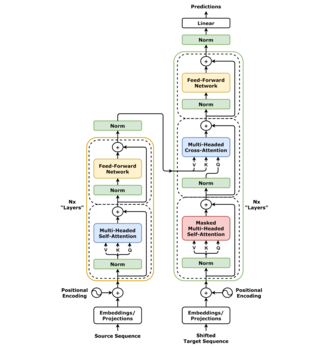
The Transformer architecture
The 2017 Attention Is All You Need paper changed AI forever. Self-attention, multi-head attention, encoders, decoders, and why transformers scale.

How ChatGPT was built
ChatGPT changed the world in two months. The technical story of GPT, RLHF, InstructGPT, and the product decisions that launched an era.
The Architecture of Modern AI: From Neurons to LLMs
How neural networks evolved into Transformers, large language models, and generative systems powering the new computing era.
The rise of large language models
How predicting the next word, at massive scale, produced systems that answer questions, write code, and explain themselves.

Meta after Facebook
A social network became a family of apps, then a bet on virtual reality, then a serious AI research lab.
What is a Transformer?
The 2017 paper that quietly rebuilt the field of natural language processing.